Friday, April 15, 2011

Adrian Gonzalez: Contract Analysis


+


The Boston Red Sox and first baseman Adrian Gonzalez finally came to a contract extension agreement.  The deal is reported to be worth 7 years and $154 million.  That's 154 followed by one million 0's.  No, actually it isn't.  But it is a lot of money.

I recently looked at the Sox' extension with Clay Buchholz and I'm going to take a similar look here.

Gonzalez has shown a pretty steady climb during his formative years with the Padres.

*Click to make bigger

Doesn't get much more consistent than that.  How this leveling off is going to go is anyone's guess but if we take a standard aging model and give Gonzo two more seasons of steady production before a half WAR decline once he reaches age 31 (in 2013) and we assume the same $5 million per WAR and 5% inflation as we did with Buchholz, we'll get the following chart.

*Click to make bigger

The Actual Salary for 2011 includes Gonzo's $5.5 million salary for the year plus the $6 million signing bonus.

Under these parameters Gonzo would provide the Red Sox with 33.5 WAR over the life of the contract. The market value of the WAR would be $194.3 million with the Red Sox paying only $159.5 million.  The $35 million Projected Savings represents the risk that the Red Sox take on.  If Gonzo's shoulder falls apart tomorrow they are still on the hook for almost $160 million.  From here, it looks like a pretty fair deal for both sides.

There is still the issue of the market.  What is the going rate for slugging first basemen?  With Buchholz we could look at his teammate Jon Lester's deal.  With Gonzalez we will look to the Red Sox' mortal enemy, the New York Yankees.

Prior to the 2009 season the Yankees signed their version of Gonzalez, Mark Teixeira, to an 8 year $180 million contract.  Teixeira was 29 in the season following his contract.  Teixeira and Gonzalez are pretty similar players as the following graph shows.

*Click to make bigger

The only real difference in their total production is that during Teixeira's age 23 season he played a full season and put up 2 WAR while at age 23 Gonzalez only played 46 games.  At age 24 Teixeira and Gonzo both played full seasons.  Teixeira put up 4.5 WAR and Gonzalez 3.9 WAR.  They've been pretty equal ever since.

*Click to make bigger

A couple of things to note.  First, the $/WAR rate in 2009 was lower-about $4.5 million.  Second, the actual $/WAR in 2010 dropped to $4 million instead of increasing 5%.  Teixeira was coming off a 7+WAR season in 2008 when he signed the deal.

Gonzalez' deal looks to be a bit better than Teixeira's.  The Yankees are over paying $5 million compared to the Red Sox saving $35 million.

One other thing to remember though, the Red Sox traded for Gonzalez (giving up prospects) while the Yankees signed Teix as a free agent (surrendering 2 draft picks).  The 'cost' of the prospects could be subtracted from the Red Sox' side of the ledger (but not added to Gonzalez' side, certainly).  And the Yankees are made out of money.

Given that, the two deals look pretty equal.

One deal that doesn't look equal is the Ryan Howard deal.

In February of 2009 the Phillies and Howard agreed to a 3-year $54 million deal that covered Howard's 2nd and 3rd arbitration years and first year of free agency.  Then, one year later, the Philles gave Howard another deal worth $125 million over 5 years.  Let's look at that deal.

*Click to make bigger
*Note: The Phillies have a $25 million option for 2017 with a $10 million buyout.  The graph assumes the Phillies decline the option.

It looks a lot different.  Using the same parameters as the Teixeira deal (the deals were signed the same year) we get the Phillies coming out almost $40 million in the red.  There are a few reasons for this.

First, Howard isn't as good as Teixeira and Gonzalez.


You can see that Howard's graph is nowhere near Teixeira's and is getting farther apart over time.  He's closer to Gonzalez', but only because of a monster year at age 26.  The gap widens every other year.

Also, Howard's deal covered 2 of his arbitration years.  Remember that in the second two years of arbitration players generally get 60 and 80 percent of their market value.

The Phillies will most likely regret this deal...well...now...but will really regret in when the the deal starts NEXT YEAR.

*Stats from FanGraphs
*Contract data from Cot's and BleacherReport 

Wednesday, April 13, 2011

Phillies' Rotation 11 Games In


There was a little bit of talk about the Phillies' rotation heading into this season.

After 10 games the results have been a bit disappointing.  The starters are:

5 - 3 5.04 ERA, 55.1 innings, 63 hits, 4 HR, 11 walks, 56 strikeouts.

That ERA is 24th in the league.  Not what Phillies phans were expecting.  It's only 10 games so there's no reason to throw in the towel yet.  Especially if we look a little bit closer at how the Phillies' starters are pitching.

ERA is a terrible way to judge a pitcher, let's look at some other stats.


Philles starters have struck out the most batters per nine innings in the majors; striking out batters 30% more often than the league average.
They have walked the least batter per nine innings in the majors; walking batters at only 55% of the league average.
They, obviously, have the best strikeout to walk ratio in the majors; 138% better than the league average.
Their FIP is the best in the league at 73% of the league average.

The Phillies' starters are dominating in most of the things that usually make pitchers successful.

The only thing that they are lagging in, and they are really lagging, is in BABIP.  The Phillies' starters have the 2nd worst BABIP in the league; 22% worse than the league average.

It is unlikely, to the point of near impossibility, that this will continue.


You can see that Lee, Hamels, and Blanton's BABIPs are impossibly higher than their career BABIPs while Halladay's is right in line and Oswalt's is much lower.

Based on the batted ball rates (GB, FB, LD, IFFB) and typical BABIPs on those batted balls (.240, .140, .740, .40) we'd expect the Phillies' starters to have a total BABIP of .311.  That'd rank them much closer to the middle of the pack and would take away a lot of those runs that have been given up.

R2C2 is going to be fine.

Plus, it's not like the bad BABIPs are killing the 7 - 3 Phillies in the standings.

Chase Utley's knee is still the biggest reason that Phillies fans have to worry.

H/T to Grandstander

Sunday, April 10, 2011

Clay Buchholz: Contract Analysis


The Boston Red Sox signed the guy in the picture above to a $30 million extension today.  That guy is Clay Buchholz.

I wrote about Buchholz' superb 2010 and projection for 2011 here.

I wrote that Buchholz isn't really as good a pitcher as his 2010 made him look due to some BABIP and LOB% luck.

So, did Buchholz get lucky with this extension or did he earn it?

One thing to look at is his partner in crime, Jon Lester.  Lester signed a similar deal after his breakout 2008 season.

Let's compare:
Buchholz 2010: 17-7, 2.33 ERA, 28 starts, 173.2 innings
Lester 2008: 16-6 3.21 ERA, 33 starts, 210.1 innings

At first glance, those would appear to be similar seasons.  Excellent win-loss records.  Buchholz a lower ERA, but Lester with a lot more innings.

Let's look at those seasons less superficially though:
Buchholz 2010: 6.22 K/9, 3.46 BB/9, 50.8% Ground Balls, 3.61 FIP, 84 FIP-, 3.7 WAR
Lester 2008: 6.50 K/9, 2.20 BB/9, 47.5% Ground Ball, 3.64 FIP, 81 FIP-, 5.1 WAR
*FIP-

So, they are coming off of two pretty similar seasons.  They are also at similar points in their careers.  In March 2009 (When Lester signed his extension), Lester had 350+ innings and 59 career starts (and one victory over leukemia).  Buchholz came into 2011 with 360+ innings and 62 career starts.

Lester's deal was structured like:
Y1 (2010) 3.75 million
Y2 5.75 million
Y3 7.625 million
Y4 11.625 million
Y5 13 million team option (250 K buyout)

Buchholz' deal will be something like:
Y1 (2012) 3.5 million
Y2 5.5 million
Y3 7.7 million
Y4 12 million
Y5 13 million team option
Y6 13.5 million team option

Again, quite similar.  The guaranteed money is basically identical (not factoring for inflation) while the Red Sox get an extra option year on Buchholz' deal.

The reaction to Lester's deal was very favorable at the time of the extension.  As it should have been as the extension has basically turned into gold.

Lester 2006-2008: 59 starts, 354 innings, 6.65 K/9, 3.55 BB/9, 4.13 FIP, 91 FIP-, 6.9 WAR
Lester 2009-2010: 64 starts, 411 innings, 9.85 K/9, 3.22 BB/9, 3.14 FIP, 71 FIP-, 11.9 WAR

According to FanGraphs' WAR to Dollar Conversion, Lester has been worth $50.9 million since signing the contract, while earning only $4.75 million.  Not a bad investment.  Lester could...bow out now...and the Red Sox would have had a net positive for the deal.  Everything that he added since the first couple of months of the 2010 season is gravy.

But this is about Clay Buchholz, who is not Jon Lester.

Buchholz entered the 2011 season with 2 years and 59 days of service time, according to Cot's (which means it is probably accurate).  If Buchholz manages a full season in 2011 then he would be eligible for arbitration following the 2011 season.  In their first year of arbitration players generally receive about 40% of their market value.  This is followed by 60% in the second year and 80% in the third year.

If we project Buchholz more pessimistically than what Lester achieved, and say that Buchholz remains about a 4 WAR pitcher until he turns 30 then decreases by half a win after that and we assume a $/WAR of $5 million this year with 5% inflation, then we get the following chart.

*Click to make bigger

Given those parameters, Buchholz would provide 22.5 WAR worth a total of $107 million, while being paid only $55.2 million-a bit more than half of that.  So, Buchholz really only has to generate around 11 WAR to earn the contract.

This is where the option years come in.  The Red Sox guaranteed only $30 million to Buchholz.  If, Buchholz is only putting up 2 WAR seasons between 2012 and 2015 then he will have provided the Red Sox with about $32 million in value, while being paid $30 million.  The Red Sox would then decline the options, and still would have broken even on the contract.  Barring injury, it is very difficult to imagine Buchholz not being at least a 2 WAR pitcher.

Of course, there is the possibility that Buchholz gets injured tomorrow and never pitches for the Red Sox again.  In that case the Red Sox lose out on $30 million.

So the Red Sox are gambling at most $30 million on the the more likely possibility to come out $50 million ahead.  Smart move.

Not bad for Buchholz to put $30 mils in the bank either.

Now, go outside and sling some baseballs through that old tire you have set up in the backyard. 

Wednesday, April 6, 2011

Fili's GOD for April 6th 2011: Tampa Rays vs LA Angels of Anaheim


Today's Game Of the Day is the Tampa Rays vs the Los Angeles Angels of Anaheim.  

The Tampa Rays burst into prominence in 2008 when they exorcised the word 'Devil' from their name and won the AL East with 31 more wins than they had the previous season. 

This year Tampa is off to a poor (0 - 4) start and what better way to get off of the schneid than by returning to their devilish roots and starting Hellboy himself, Jeremy Hellickson.  And they are, you know, playing the Angles.

http://www.draysbay.com/

Hellickson is one of a seemingly infinite number of top prospects in the Rays' system.  In 580 career minor league innings, Hellboy has a 2.71 ERA, 2.1 BB/9 and 9.8 K/9.  

Hellickson displayed the same dominance in 36 major league innings last year.  3.47 ERA, 1.98 BB/9 and 8.17 K/9.  

Hellickson doesn't have the amazing fastball featured by many top prospects.  His fastball clocked in at about 92 MPH last season.  His devastating pitch is his changeup.  Hellickson through the changeup about 29% of the time last season, one of the highest rates in the league.  In contrast he threw his fastball only 53% of the time, one of the lower rates in the league.  

In the small sample, Hellickson's change saved 2.96 runs per 100 pitches.  If he had that rate for a full season he would have had the 3rd most effective changeup in the majors last year.  Behind only Felix Hernandez and Shawn Marcum.

Hellickson also throws a curve (17%, -.94 runs saved per 100) and a pitch labeled as a cutter, though that may be just noise since it was only thrown 1% of the time.

Hellickson shows good stuff with a 73% contact rate (88% league average) and 13% whiff rate (9% league average).  

Hellickson had some trouble with lefties last year (5.63 FIP vs L, 2.22 FIP vs R).  That's a very small sample though and it shouldn't be expected to continue so dramatically since changeups are usually effective against opposite handed hitters.  The Angels don't have much in the way of left-handed bats (sorry Bobby Abreu and switch-hitting Maicer Izturis). 

Whether or not Hellickson dominates tonight, expect him to have a good season and career.  

Hellickson isn't the only player going tonight.

The Angels' Dan Haren is an outstanding pitcher as well.  Haren had a down year last year; 3.91 ERA and 3.71 FIP compared to 3.23 and 3.12 over the last 2 years.  

Johnny Damon will be DHing (with good reason).


UPDATE:

Hellickson was pretty awesome.  He struck out 5 in the first 2 innings, and 10 of the 25 batters that he faced while walking only 2.  He did give up a jack to Alberto Callaspo.

Brooks Baseball says Hellickson:
threw 99 pitches
38 fastballs, 24 for strikes, 2 swinging strikes at an average of 89.5 MPH
30 changeups, 19 for strikes, 8 swinging strikes
26 curveballs, 20 for strikes, 9 swinging strikes
5 cutters, 1 for a strike

Excellent mixing of his pitches.  Excellent strike rates and excellent swinging strike rates.

Hellboy didn't disappoint even though Tampa drops to 0 - 5.
*****************************************************************

There was another amazing game.

I only got to see Jeff Francis deal to a couple of hitters while taking a quick break from shingling my Grandfather's house.  I missed a doozy of an ending.


The biggest play, in terms of WPA, was Carlos Quinten's double with the Sox down 1 with 2 outs in the top of the ninth facing Royal's closer Joakim Soria with 2 strikes.

When the at bat started, the Royals had an 83% chance of winning.  After Quinten's hit, the [i]Sox[/i] had an 83% chance of winning.  Talk about turning the game in your favor.

The entire ninth inning was insane.  When the inning started the Royals were up 6 - 3.  They had a 96.5% chance of winning.
AJ Pierzynski grounded out.  98.5% chance of Royals winning
Morel grounded out.  99.6% chance of Royals winning
Pierre single. 98.8%
Beckham walk. 96.6%
Rios single scores Pierre (6-4). 92%
Konerko single scores Beckham (6-5). 83.4%
Quentin double scores Beckham and Lillibridge (6-7). 17.4%
Ramirez flies out. 20.8%

Gordon strikes out.  11.7%
Butler singles. 21.6%
Dyson steals 2nd. 28.7%
Ka'aihue double scores Dyson. (7-7) Royals now have a 70.2% chance of winning.
Francoeur walks. 71.1%
Escobar grounds into a fielder's choice. 64%
Pena grouns out. 50%

That is absolute madness.  The Royals went from 99.6% chance of winning to a 88.3% chance of losing to a 71% chance of winning to even odds-in one inning.

Baseball is awesome.


Tuesday, April 5, 2011

Debut Review: Alexi Ogando and Michael Pineda

Two interesting pitchers made their debuts as major league starters today.

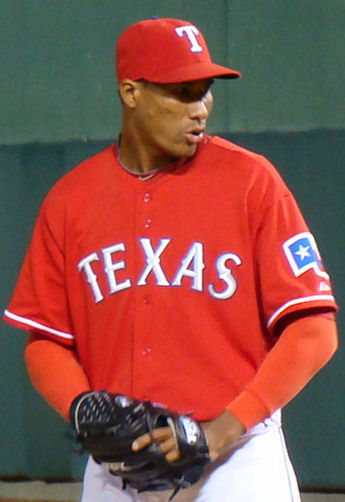
The Texas Rangers' Alexi Ogando


and the Seattle Mariners' Michael Pineda.


Ogando pitched in relief for the Rangers last year while Pineda is one of the Mariners top prospects.

I said this earlier today:
An interesting game today that, unfortunately, I'll be too busy to either watch or keep tabs on:
Seattle at Texas. While Texas is really good and Seattle, likely isn't, both teams will start pitchers making their first career starts. 
Alexi Ogando starts for Texas while Michael Pineda goes for the Mariners. 
One specific thing to watch will be how both pitchers fair against left-handed hitters. As is the case with most young pitchers, both have explosive fastballs and questionable secondary offerings. Those 'secondary offerings' are change-ups in both cases. 
Ogando used his change up only 5% of the time last season as a reliever. It rated as a basically average pitch according to FanGraphs' pitch type values. Alexi Ogando » Statistics » Pitching | FanGraphs BaseballOgando dominated right-handed batters to the tune of 10.4K/9, 2.2BB/9 and a 2.07 FIPLeft-handed hitters were a different story: 4.15K/9, 6.23BB/9 and a 5.23 FIP.The raw numbers:vs L: 58 batters faced, 11 hits, 9 walks, 6 K'svs R: 113 batters faced, 20 hits, 7 walks, 33 K'sOgando will have to face a few lefties today including: Ichiro, Jack Cust, Milton Bradley, Ryan Langerhans or Michael Saunders, Justin Smoak, Chone Figgins, and Adam Kennedy.
Pineda will have to face a few lefties as well: Josh Hamilton, Mitch Moreland, Julio Borbon, and David Murphy.
How their off-speed pitches are working will go a long way to determining how successful they are against these lineups.
So, how'd they do?

Ogando pitched 6 innings giving up 2 hits, 2 walks and striking out 4.  He held Seattle scoreless.
Pineda pitched 6 innings giving up 5 hits, 1 walk and striking out 4.  He gave up 3 runs.

They both pitched pretty well.  My main concern was how they would fare against left-handed batters.

Ogando allowed 4 base runners, all of them left-handed.  However, most of Seattle's lineup was left-handed, so it's not surprising that he'd give up some hits to lefties.
Single to Bradley, BB to Cust, 2B to Kennedy, BB to Bradley

Pineda allowed 5 base runners, 3 of them left-handed.
Pineda: 3B to Moreland, 2B to Moreland, 1B to Kinsler-R, 2B to Hamilton, 2B to Young-R
Righties were were 2 - 17 with a walk and 3 strikeouts.
Lefties were 3 - 7 with 2 doubles and a triple.  Moreland isn't a great hitter but a lot of guys have given up doubles (or more) to Hamilton.

This isn't enough data to confirm that either pitcher will struggle with lefties, but let's take a look at how they approached them.

First Ogando,
According to Brooks Baseball, Ogando threw 78 pitches: 49 fastballs (63%), 28 sliders (36%), and a single change-up (1%).   According to FanGraphs, last year Ogando threw fastballs 64% of the time, sliders 31% of the time, and change-ups 5% of the time.  Interesting that he pitched almost exactly the same as a starter as he did out of the pen.  That's one way to eliminate concerns over his change-up; don't throw it.

It appears that the change-up that Ogando threw was the first pitch to Chone Figgins in Figgins' at bat in the 6th inning.  It was a ball clocked at 84 MPH.  He followed that up with a 93 MPH fastball for a strike, a 83 MPH slider for a ball, and another fastball that was grounded back to Ogando.

Ogando's fastball averaged 94 MPH with a high of 96 MPH.  Last season his fastball averaged 96.3 MPH.  A two MPH drop is reasonable when going from the bullpen to the rotation.  Ogando's slider averaged 79.5 tonight compared to 81.9 last season.

As for Pineda,
Brooks Baseball shows Pineda throwing 73 pitches in his 6 innings.  46 of them were fastballs and the other 27 were sliders.  Pineda completely avoided throwing any off speed pitches.

Pineda's fastball averaged 93.9 MPH while maxing out at 97.7.  His slider came in at 83.3 MPH on average.

It appears that both teams shared the concerns about their young pitchers' tertiary offerings, and didn't have them throw them.  Today, their stuff was good enough that they could get away with it.  At some point both guys will have to expand their repertoire to continue to have success as starters.  

Thursday, March 31, 2011

2011 Major League Opening Day

First day of baseball.

It's spring.

It's baseball.

New life.

Baseball.

Rebirth & Renewal.

Baseball.

Opening Day.

Time to open something.


How'd Opening Day go?


Booya!  Faces off vs Tim Lincecum tonight.  Let's go BLUE

2012 Dodger Roster Early Preview

Well, we finally know what the 2011 Opening Day roster is going to look like.  It's time to look ahead to 2012.  A lot will depend on performance, injuries, trades, development, etc...but there is definite potential for next year's team to look a lot different.

*Click to make bigger

We see a lot of 'Free Agent's and 'Team Option's on the 2012 side of that roster.  Let's take a look and see what we think is likely to happen with each player.

C Rod Barajas
Barajas signed a 1-year deal to replace Russ Martin.  We don't know exactly how that's going to work out yet but we can (hope) be sure that at 35 years old the Dodgers don't see Barajas as the long-term answer at catcher.   However, the Dodgers don't have much at the position in the minor league system.
Chance of Returning: low to medium

C AJ Ellis
Ellis is an interesting player.  In his minor league career he's shown a very good ability to draw walks (.398 OBP, 15% BB/PA) while displaying no power (.375 SLG).  The though on Ellis as a major leaguer has always been that pitchers would just pitch him down the middle since there's little chance of him hitting an extra base hit and a single is no worse than a walk, most of the time.  In Ellis' limited major league experience, he has shown the ability to walk (10% BB/PA) against major leaguers.  Ellis has good bat control showing only a 4% whiff rate (8.5% average) in the bigs.  IF Ellis can continue to get on base he'll make an adequate backup catcher.  Since Ellis has an option left I think his...
Chance of Returning: medium

C Hector Gimenez
Full disclosure: I'd never heard of Gimenez until it appeared that he was going to make the roster.  Gimenez has appeared in 2 major league games in his career, in 2006 for the Astros.  He went 0 - 2.  In his minor league career he's never shown any exceptional ability to hit for power (.403 SLG) or to get on base (.318 OBP).  Word on the street is that he's not a good defensive catcher (hence the need to have Ellis as a backup catcher).  I'd be surprised if Gimenez finishes the season with the Dodgers, let alone begins next season with them.
Chance of Returning: very low

1B James Loney
Loney's offense has been stagnant to going-the-wrong-way since his rookie season while his salary is starting to climb.  2011 should be the decision year for Loney and the Dodgers as to his long-term future with the team.  If Loney can show improved power in 2011 he's probably worth 7-8 million in 2012.  If it's Loney as usual then his 2012 salary will likely outweigh his production and it will be time for the Dodgers to look elsewhere.  The Dodgers reportedly listened to offers for Loney this off seasons, and discussions with the Nationals  were particularly involved.  Also 2011 rising prospect Jerry Sands is a possibility for 1B in 2012.
Chance of Returning: medium

2B Ivan DeJesus
DeJesus was a highly regarded prospect until a 2009 injury sidelined him for the season.  His 2010 wasn't up to the pre-injury standards and he lost some of his luster.  He'll have a few games (ideally more) to impress new manager Don Mattingly at the beginning of 2011.  I'd like to see DeJesus hold down the starting 2B job (at least until Casey Blake returns, and maybe even after) and then stay on the team as a backup infielder in place of Aaron Miles.  DeJesus has options and should be back next season either in LA or Albuquerque.
Chance of Returning: medium

3B Juan Uribe
"World Series Hero" Juan Uribe signed a 3-year deal with LA prior to 2011 so he should be around in 2012.  What position he will play is certainly up for debate and is dependent on what happens with some other players (Blake, Furcal, Gordon, DeJesus).
Chance of Returning: very high

SS Rafael Furcal
Furcal has been a very good player in the 4 seasons he's played in LA.  Unfortunately, those 4 seasons have been spread out over 5 years.  If Furcal can stay somewhat healthy in 2011 I think LA has to pick up his 2012 option.  Dee Gordon is an interesting (polarizing.  Some think he's the bee's knees, some don't get all the buzz) prospect but unless he really shows something in 2011 I doubt LA will turn over SS to him in 2011.
Chance of Returning: high to med

IF Jamey Carroll
Carroll had a surprisingly productive 2010 filling in for Furcal, Blake, and Blake 2 De(return)Witt. Carroll put up a career high (by 1 point) on base percentage.  His 2.4 WAR almost matched his combined total for the previous 3 years (2.9).  He's going to be 37 this year, 2 years older than the first time he signed with LA but if he performs again he may be back.
Chance of Returning: low

IF Aaron Miles
Miles isn't really a good player.  His bat (as measured by wRC+) is 72% of the average major leaguer's bat.  And his defense is no real reason to have him on the roster either.  At least he isn't Juan Castro.
Chance of Returning: very low


LF Tony Gwynn jr.
Gwynn signed with LA a year after...sucking at hitting the ball with San Diego.  Gwynn should see a lot of time spelling Thames et al in LF and pinch running.  There's also a chance that Gwynn gets some at bats and does something with them or the Dodgers become totally enamored with his defense.  Gwynn is eligible for arbitration so if he performs the Dodgers can bring him back.
Chance of Returning: medium

CF Matt Kemp
Kemp looked poised for stardom following a 2009 season in which he put up 5 WAR and improved his:  walk rate, strikeout rate, on base percentage, slugging and UZR.  Unfortunately, 2010 saw him date Rihanna and everything possible about his game suffered (not to imply causation).  Unless he slips even further in 2012 'the Bison' will almost surely be back for 2012.
Chance of Returning: very high

RF Andre Eithier
Eithier, like Kemp, signed a 2-year deal prior to 2010.  Also like Kemp, Eithier exploded out of the gates in 2011 (.428 wOBA in April, .585 wOBA in May).  Then Ethier broke his pinky finger and couldn't pick up where he left off.  Either has been a steady performer though and there's no reason to think that his 2011, and then, 2012 would be any different.
Chance of Returning: very high

OF Marcus Thames
Thames signed prior to 2010 to be 1/2 of a LF platoon.  Unfortunately, he doesn't really have a platoon partner.  Being a platoon guy without a partner is much like not having a place on a team.  Not having a place on a team makes one unlikely to be on the team-especially two years in a row.  There's always a chance that the 'left' portion of the LF platoon sucks so bad the Thames gets at bats vs righties.  If that happens there's a chance he hits some home runs vs those righties.  If that happens there's a chance Colletti signs him to a 3-year $30 million deal[/hopefully sarcasm].
Chance of Returning: Low

OF Xavier Paul
Paul has put up some decent minor league numbers but shown nothing in a few major league at bats.  In the minors Paul showed a decent ability to get on base (.360 OBP), hints of doubles power (.449 SLG), some speed and a glove that might be adequate in center and good for the corners.  Paul is quite useful as a 4th or 5th outfielder.  If the Dodgers don't see Gibbons as a starting outfielder when he comes off the DL then Paul will have a chance to stick with the team through the season.  I think this is in the Dodgers' best interests.  As Paul is out of options, he cannot be sent to the minors without clearing waivers-and I think some team would claim him.
Chance of Returning: low


DL-3B Casey Blake
Blake came over at the 2008 trade deadline.  He performed will in 2008 helping LA to the NL West championship.  2009 was an excellent year for Blake as he put up 4.6 WAR.  2010 was seen as a down year for Blake but he still managed 2.8 WAR which is a typical Blake season. A decline in offense (especially against right-handed batters) have many bloggers calling for Blake's head (or at least his butt on the bench) but I'm not convinced that he's finished.  Still, what happens to Blake in 2012 depends on how he performs in 2011 as LA has a team option for the season.  Starting the season on the DL doesn't help (him).  What might help him is that the Dodgers don't have any 3B prospects ready to contribute though Juan Uribe could play third.
Chance of Returning: medium


DL-C Dioner Navarro
Navarro was acquired by LA in 2005 for Shawn Green and anointed Dodgers' catcher of the future.  Well, now it is 2011 and here's Navarro.  Navarro actually got a chance in 2005 and 2006 with LA and played pretty well.  But he got Wally Pipped by Russ Martin. Navarro had a good 2008 with the Rays and has been terrible since then.  Just 27, he has talent, and he deserves a chance.  One million bucks is a low risk gamble to see if Navarro can become useful again.
Chance of Returning: low


DL-OF Jay Gibbons
Gibbons played well in Baltimore in 2002 and again in 2005.  Baltimore is a long ways away from LA and 2005 is a long time away from 2011.  Gibbons did put up a .346 wOBA in 80 at bats for LA last year.  Then this spring he got new contacts, didn't have any depth perception, couldn't hit or catch the ball.  The chance that Gibbons has a good year this year: small.
Chance of Returning: very low


SP Clayton Kershaw
23 years old.  26 - 23 3.17 ERA, 483 innings, 497 K's.
Chance of Returning: 97.9%+the title of Jonah Keri's new book.

SP Chad Billingsley
CBills and Kershaw are about the best #2 and #1 rotation pitching you could reasonable expect your farm system to produce at the same time.  CBills has put up strong number every year since his call up in 2006.  LA needs to lock both pitchers up for the next few seasons.  EDIT:  Billingsley has agreed to a 3 year extension + an option for the 4th year.

SP Hiroki Kuroda
Kuroda signed a 3 year deal prior to the 2008 season and has pitched 3 solid seasons.  Kuroda apparently decided he would either stay in LA or return to Japan following 2010.  Obviously, he chose to stay in LA.  He'll likely face the same decision after the season.  Kuroda will be a valuable trade piece at the deadline but I'd hate to see the Dodgers send him away after he's made it clear he wants to stay in LA and signed a below market deal to come back in 2011.
Chance of Returning: medium to low

SP Ted Lilly
Lily was acquired at the 2010 deadline.  He pitched well for LA down the stretch.  After Cliff Lee...way after Cliff Lee...he was on of the top free agent starters following the season.  The Dodgers had only Kershaw and Billingsley in the rotation so they signed Lilly for 3 years.  Lilly should pitch well enough in 2k11 to avoid being released and should be back in 2012.
Chance of Returning: very high

RP Jon Broxton
Broxton was lights out until Joe Torre ruined him by allowing him to throw about 1000 pitches in 4 consecutive games in June then it all went to crap.
MONTH FIP
APR 1.18
MAY 1.83
JUNE 2.24
JULY 4.22
AUG 4.04
SEP 7.00
If Broxton returns to pitching like he did pre 2nd half of 2010, he'd be a nice trade piece for a contender. If he doesn't, the LA won't want him back on the $10 million contract he'd likely earn in arbitration.
Chance of Returning: low

RP Hong-Chih Kuo
Kuo has had eleventy surgeries on his left arm, but he still manages to dominate opposing hitters.  Kuo struck out 28 of 69 left-handed batters in 2010 while allowing 6 hits.  Next year will be Kuo's last year of arbitration and if he remains healthy in 2011 there's no reason that he shouldn't return to LA for 1 more year.

RP Matt Guerrier
Guerrier is an average reliever who's been able (lucky?) to end up with mostly above average results.  I hope that continues to because he's gonna be in LA for a while.
Chance of Returning: very high

RP Kenley Jansen
Jansen was a minor league catcher a year and a half ago.  Now he's a major league relief pitcher.  Jansen blew hitters away in both the minors (15.4 K/9) and the majors (13.7 K/9).  The walk rate (5+ BB/9) and the rawness make me temper the 2011 a bit.  I look forward to 2012 and beyond.
Chance of Returning: very high

RP Blake Hawksworth
Hawksworth was highly rated prospect in the Cardinals system but never really panned out.  He's pitched 130 major league innings of replacement level ball.  He'll be eligible for arbitration after the season so if he pitches well the Dodgers can bring him back.
Chance of Returning: low

RP Mike MacDougal
MacDougal has saved 70 big league games in his 10 seasons.  Not that saves really mean anything other than MacDougal's been around.  There was a time when MacDougal had the stuff to strike out around a batter per inning but recently he's been striking out about a batter per walk.
Chance of Returning: very low

RP Lance Cormier
Lance Cormier made the team.  He walked more than he struck out last year.  Cormier has been around and we know what he is-a completely replaceable pitcher.  He won't last the year in LA, let alone next.
Chance of Returning: very low

DL Jon Garland
Garland returns for his 2nd stint in blue.  The first was 6 starts in 2009.  Garland is more known for his durability than for his skill.  Of course, he starts 2011 on the DL.  The 2012 option becomes guaranteed with 190 innings pitched in 2011.  What was likely to vest now becomes less likely.  For the option to be picked up Garland would have to pitch well enough to out earn the contract AND the Dodgers would have to have $ to spend in 2012.  
Chance of Returning: low to medium

DL Vicente Padilla
Padilla has been around (4 teams) and has generally pitched well.  He posts decent ground ball rates and averagish K and BB rates.  His 134.1 (is that really all?) innings in LA have well exceeded his career averages.  Padilla signed a incentive laden $2 million contract to pitch for LA in 2011.  It was unsure at the time (and still is) whether he'd pitch out of the pen or in the rotation.  Padilla's return depends on his 2011 performance (of course) and other roster decisions (of course).  It's not out of the realm of possibility that the Dodgers could be in a similar situation next year.
Chance of Returning: low to medium


There's a lot of empty spaces on the right side of that roster.