Sunday, July 29, 2012

2013 Phillies: What to expect

The Phillies have been one of the most successful and talked about teams of the last decade.  They've appeared in 2 World Series, winning 1.  They've won their division 5 consecutive years.  They've increased their win total for 5 consecutive seasons.  They've averaged 90 wins per season over the last 10 years and 95 wins per season over the last 5 years.  They've made huge waves on the free agent and trade markets.  The City of Brotherly Love has had ample reason to love their Phillies.

This year has been different.  

Last season ended unceremoniously with the Phillies losing in the NLDS to the Cardinals and Ryan Howard tearing his ACL while making the final out.   

This season picked up as poorly as the last left off.  Howard missed the first 3 months of the season.  Chase Utley missed the same.  Roy Halladay uncharacteristically spent time on the DL and hasn't been himself.  Cliff Lee is 1 - 6 with an ERA closer to 4 than to 2, or even 3.  They are 11 games under .500.  

In short: Disaster.

Many say that the Phillies are finished.  They are old and overpaid.  One of the worst teams in baseball nex year.  Are they right?

Let's break down the Phillies by position.

Position.  2012 Player.  2013 salary

Catcher: Carlos Ruiz.  $5 million team option that is almost certain to be picked up.
Ruiz has been a solid catcher for a good portion of Philly's run.  This year he's been the team MVP.  He's always posted solid OBP numbers, this year he's added about 50 points to his career OBP.  He's also turned into a slugger; 14 home runs and an additional 150 points of slugging percentage.  Ruiz is unlikely to continue at this pace, but he's an excellent player for the Phillies, especially at $5 million.

First base: Ryan Howard.  $20 million in year 2 of a terrible 5 year extension.  
Howard is one of the most overrated players in baseball; also one of the most over paid.  That doesn't make him a bad player.  The Phillies certainly missed his offense early in the season.  He's only played a few games since coming back but he looks like the same Ryan Howard that we've known.

2007-2011: .358/.539 (OBP/SLG) which was 29% better than the league average hitter.
16 2012 games: .344/.500 (OBP/SLG) which is 29% better than the league average hitter.

No reason to think that Howard's injury is causing any decrease in performance.  

Second Base: Chase Utley.  $15 million in the final year of his contract.  
Utley also missed most of 2012.  Unlike Howard, Utley's injuries do seem to be taking a toll on him.  Between 2005 and 2010 Utley was one of the best players in baseball.

2005-2010: .388/.523 (OBP/SLG) which was 38% better than the average hitter.
Then the injuries hit
2011: .344/.425 - 16% better than the average hitter

Thus far in 2012: .340/.481 - 18% better than the average hitter.

Utley is no longer one of the best players in all of baseball.  Now he's one of the best second basemen in baseball, when he's on the field.  How much he'll be on the field in 2013, is a big question.

Third Base: Placido Polanco.  $5.5 million mutual option.
Polanco's signing was met with skepticism by many but it's worked out well for Philadelphia.  Formerly a second baseman, he's played exceptional defense at 3rd.  His bat has been in decline though.  He was a well above hitter from 2003-2008.  In his time with the Phillies his offense has been close enough to average that his defense was able to make him a productive player.  This season, his defense looks to be slipping and his bat is useless at 31% worse than average.   I don't think that Philly will bring Polanco back for another season.  

Shortstop: Jimmy Rollins.  $11 million
The arrival of Rollins began the Phillies ascent to dynasty status.  He's put up 46 WAR in the 11+ seasons since becoming the Phillies' starting SS in 2001.  From 2004-2007 he average over 5 WAR per season.  He's fallen off from those numbers but he's still a solid player and is on pace for about 4 WAR this season.  

Reports of Rollins' demise appear to have been premature.

Left Field:  Juan Pierre.  Free Agent
Left field has been a position of weakness for Philadelphia.  It was manned by Raul Ibanez from 2009-2011.  Ibanez had a surprisingly productive 2009, a poor 2010 and a horrific 2011.  Prospect Domonic Brown was supposed to take over in 2012, but he's shown nothing in 270 major league plate appearances and has struggled in the minors as well.  Juan Pierre played himself into the position with a resurgent year of average offense and below average defense.  He's on pace for less than 2 WAR and Philly should be looking for an upgrade in 2013 as Pierre is unlikely to match this production again.  

Phillies' fans also had high hopes for John Mayberry Jr after a 2011 performance that saw him hit 33% better than the average hitter with a .341/.539 (OBP/SLG) line.  Predictably, he hasn't been able to maintain that pace and has only hit .271/.388 (OBP/SLG) this season, which is 25% worse than the average hitter.  

The Phillies will have opportunity to upgrade this position for 2013.  

Center field: Shane Victorinio.  Free Agent.
The Flyin' Hawaiian has been another core player for Philadelphia.  His .350/.440 (OBP/SLG) offense (12% better than average) and good defense has produced 24 WAR for Philadelphia from 2006 to 2011.  That's 4 WAR per season.  This year he's only hitting .320/.390, which is right at average production, but with league offense down he's still on pace for over 3 wins.  At 32, Philly should probably start to expect some decline and might be wise to look elsewhere for a center fielder for 2013.  

Right Field:  Hunter Pence.  Eligible for arbitration.
Pence came to Philadelphia last year and hit his way into the hearts of the Philly fans.  With Houston, Pence generally hit about 15% better than the league average hitter.  In the final 2 months of 2011, with the Phillies, he hit 58% better than the league.  He, predictably, hasn't been able to sustain that type of performance and is hitting 10% better than the league in 2012.  

Pence made $10.5 million this year and will likely make around $15 million next year.  The Phillies may elect to sign him long-term if they can agree to a good price.  


Philadelphia doesn't have too much in the way of position player prospects waiting in the minors.  Their two top position player prospects were outfielder Domonic Brown and infielder Freddy Galvis.  Brown has played himself out of that status and Galvis is currently serving a 50 game suspension for failing a drug test.  

What should we expect out of the Phillies' starting 8?
Catcher Carlos Ruiz: One of the top players at his position.  3.5 WAR
First baseman Ryan Howard: Should return to average production.  2 WAR
Second baseman Chase Utley: Will produce when he plays.  How much will he play?  1.5 WAR
Third baseman:  Who's on third???
Shortstop Jimmy Rollins: Still a solid contributor.  3 WAR
Leftfielder:  ???
Centerfielder: ???
Rightfielder Hunter Pence:  2.5 WAR

Even with the question marks the Phillies' starting 8 should provide about 13 WAR.  With replacement level being about 43 wins we get up to 56 wins before considering the Phillies' obvious strength, the pitching staff. 


Wednesday, July 25, 2012

Trade Review: Hanley for Eovaldi

Not a lot of time to do this, this "real job" really gets in the way...

From Twitter generally, and Ken Rosenthal specifically
BREAKING: Sources tell me and to , Eovaldi and prospect to .
The Dodgers also receive reliever Randy Choate and give up minor-league reliever Scott Mcgough.

First, the easy part of the deal to comment on, Choate for Mcgough.  Choate is a LOOGY and an effective one.  For his career he's struck out 28% of left-handed batters while walking 7% and allowing batted balls that suggest he should give up 2.5 runs per 9 innings.  At the same time he's struck out just 11% of righties while walking 15% and should be giving up 5.5 runs per 9.   LA should rarely allow him to face a right-handed batter.  Choate will join Scott Elbert as lefties in the Dodger pen.

McGough came in 34th on this list of LA's top 200 prospects.  He has decent minor league numbers and the scouting reports are pretty good, but, as a minor league relief pitcher he just doesn't have much value.  There is every possibility that Choate will provide more value from here on out than Mcgough  will.


Now...Hanley.  Hanley used to be a top offensive performer.  Between 2006 and 2010 he was consistently hitting more than 30% better than a league average hitter.  That is excellent for a SS. His defense left a lot to be desired, but he was a very valuable player contributing at least 4.5 wins above replacement in each season.  Then came the last 2 seasons. His hitting has been roughly league average.    He's seen an uptick in strikeout rate and a downturn in power but the biggest problem has been a sever drop in BABIP.  In his prime seasons about 33% of his batted balls became hits.  The last two seasons that number is closer to 27%.  He's hitting the same number of line drives, ground balls and fly balls so I'm not sure why the change.  The internets also haven't come to a consensus on what happened to Hanley.

Regardless, he's still a marked improvement on what LA's been running out at the hot-corner this year.  Dodger 3Bmen are hitting just .306/.369 (OBP/SLG) while Hanely has managed .322/.428.  Hanley may also see time at SS where Dee Gordon and company have "hit" .285/.320.  Hanley is an offensive upgrade.  His defense has never been great, or good, or average, but it't hasn't been terrible either.  Hanley will be an upgrade over either Uribe or Gordon depending on where he plays.

Hanley is signed for about $15 million a season through 2014.  He's on pace for about 3 WAR this season.  1 WAR is generally considered to be worth about $5 million on the open market.  3 * $5 million = $15 million.  Hanley should be worth something like what he's getting paid.

Now, Eovaldi.  Eovaldi's stock has risen rather rapidly recently (alliteration for the win!).  He was most recently number 6 on the aforementioned top 200 list.  Just 22, he's thrown about 100 innings in the bigs and hasn't embarrassed himself; striking out about 15% of batters while walking 10% and pitching in a way that would be expected to give up about 4.5 runs per 9.  That's a decent #4 starter.  Plus he has room and time to improve.  He's not a star, but he's a quality major league pitcher.

My official take on this trade.  I like it.  LA has nothing in the pipeline in the infield so having Hanley at 3B for the next 2+ seasons works.  Gordon isn't a sure thing at SS so Hanley could end up there as well.  The Dodger offense, outside of Kemp, Ethier and the first half of AJ Ellis' season, is pretty poor so even an average bat is a significant upgrade.

Eovaldi is a useful pitcher, but not a star. LA a solid rotation in Kershaw, Billingsley, Capuano and Harang.  Ted Lily is on the DL but all signs point to Ryan Dempster donning blue for his next start and all of LA's top prospects are pitchers.  And Rubby de la Rosa should be in the mix in about a month or so.

For once Ned didn't get taken to the cleaners in a trade.  Now, we'll see what he gives up to get Dempster.


Sunday, July 1, 2012

Debut Review: Martin Perez


Martin Perez' first start was pretty successful.

5 + innings giving up just 2 runs on 1 walk, 5 strike outs, a HR and 7 ground balls.  That effort translate into an expected runs allowed of 4.92 per 9 innings.

Martin has a history of walking a lot of batters in the minors (3.8 BB/9 in 2010 and 2011), so it was good (for those affiliated with the Rangers) to see him avoiding the walks.  He did give up a lot of line drives (the reason for the high expected runs allowed) which may have been the result of throwing some meatballs.


We can see a lot of pitches over the center of the plate, and not a lot on the corners.  Martin will probably have to locate his pitches better in the future to continue getting this type of favorable result.

For the game Martin threw 103 pitches, 59 for strikes.  League average strike% is about 63% so Martin was a bit below that.


According to Brooksbaseball, Martin threw 25 4-seam fastballs at about 93 MPH, 36 2-seam fastballs at 92 MPH, 28 changeups at 82 MPH, 13 curve balls at 75 MPH and 1 82 MPH pitch was labelled a slider.

His most impressive pitch looks to be his changeup.  Martin induced 5 swinging strikes on his changeups, that's an 18% swinging strike rate.  League average swinging strike rate is around 9%, so his changeup looks like a good pitch.  Unfortunately, Martin didn't get a swinging strike on any of his other pitches.

The Rangers indicated before the start that they were undecided if Perez would stay in the rotation.  While his results make him look like a major league pitcher, his process leads one to believe a bit more time in the minors might be necessary.

Saturday, June 23, 2012

Baseball people that don't understand baseball


Came across this article on MLB.com

Ken Gurnick, writer for MLB.com: The Dodgers will suffer through the 0-for017 and .220 batting average young shortstop Dee Gordon had after Friday night because there will also be games like Saturday's.

Don Mattingly, LA Dodgers manager: Dee really got us a couple all by himself.  All the time we talk about what Dee doesn't do.  Today he gets hits, steals a bag, scores twice.  He was exciting today.

Really?

Gordon scores 2 runs today and that is supposed to off set a .270 On Base Percentage and an overall offense that is about half what an average major league hitter produces

That's probably not Gordon's true talent level though.  He's probably more of a .300 OBP guy which'd make him about 25% worse than the league average hitter...still not good.  If Gordon could get on base at a reasonable clip the Dodgers would score more runs than they will be relying on Gordon's speed to create errors.


So Mattingly and Gurnick appear to be giving Gordon all the credit for the first inning run.  After singling, Gordon stole 2nd base and then scored on this error by Albert Pujols.  According to Tom Tango's run expectancy matrix, with a runner on first and no outs an average team will score .95 runs.  That the Dodger scored in that situation is no huge surprise (unless you've been following the Dodgers' offense recently), it is what is expected.  Still, we'll give Gordon the difference between the 1 run that actually scored and the .95 expected runs.  That's .05 runs.

Then, in the sixth inning, Gordon hit a triple (well, Mark Trumbo misplayed a line drive into a triple).  With no outs and a runner at third run expectancy is 1.48 runs.  Gordon's speed likely allowed him to reach 3rd instead of 2nd as Trumbo retrieved the ball quickly and made it a close play at 3rd.  Most other runners likely would have had to stop at 2nd.   Run expectancy with a runner at 2nd and no outs is 1.18.  So, we'll give Gordon credit for getting to third and credit for increasing the Dodgers' run expectancy by .3 runs.

Gordon's base running can be credited for .35 runs in this game.

Some people will say that since the Dodgers didn't get any hits after Gordon's and Hairston's ball might have been a double play had Gordon not stole 2nd Gordon should get all the credit for the first run .  It is true that the Dodgers didn't get any hits, however, after Gordon stole 2nd the Angles may have pitched Hairston differently than they would have had Gordon been on first.  They may have lined up defensively differently.  They may have pitched subsequent hitters differently had Gordon not scored.  We can't say that the Dodgers hitters would have had the same result.

Plenty of people will still say that that is a bunch of hooey.  :rolleyes:  Ok then, after Gordon's triple Jerry Hairston had this single that scored Gordon.  You can see that Izturis almost made a play on it since he was near 3rd keeping Gordon close.  Had Gordon been at 2nd then Izturis would have been farther from the line and the ball likely would have gone down the line for a double.  Gordon would have scored anyway and Hairston would have been at 2nd instead of 1st.

Anyways,  Gordon's great game lead to the Dodgers scoring about .35 more runs than they likely would have scored without him.

But, how many runs has he cost the Dodgers by not being able to get on base?  That's a lot harder to figure out.

Gordon has 280 plate appearances on the season.  He's been on base (by hit, walk, and hit by pitch) 75 times and scored 31 runs.

Given the league average OBP of .319 an average hitter would get on base 89 times in 280 plate appearances.  That's a difference of 14 times on base over the course of the season so far.

The league average hitter has scored 9022 runs on 25202 times on base (by hit, walk, and hit by pitch). That's a rate of a run scored per each .35 times on base.

.35 times the 14 extra times on base is 5 extra runs scored by an average hitter.

5 runs divided by the .35 runs that Gordon was credited in this game is 14.  Gordon would have to have a game like this every 14 games to score an equal number of runs as an average hitter.

I don't know how to check that, but that seems like a rather high frequency of excellent games out of Gordon.

Yeah, Gordon is an exciting player who makes a lot of plays with his legs and his fun to watch, but his overall performance is sub par.  The Dodgers should not put up with hit current level of performance because he'll have the rare game where his legs change the game.

The Graphic Steve Blass Disease

Steve Blass disease is the second most infamous disease named after a baseball player.

Steve Blass disease is defined (by wikipedia) as players who inexplicably and permanently lose their ability to accurately throw a baseball.

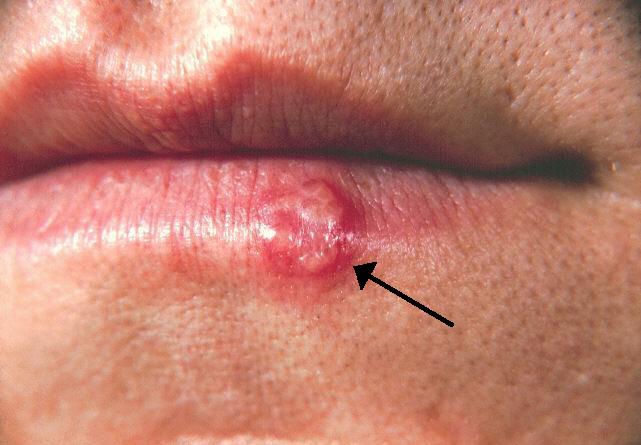
Well herpes is
viral disease from the herpesviridae family caused by both Herpes simplex virus type 1 (HSV-1) and type 2 (HSV-2)*wikipedia


That description doesn't really tell you what herpes looks like though.  Wanna see what herpes looks like?  Click here.  *I could have linked to worse, but didn't feel it necessary.

Likewise, the definition of Steve Blass disease doesn't tell you what it looks like.

Ready?

It looks like this.

*http://www.fangraphs.com/graphs.aspx?playerid=1001058&position=P&page=2&type=full

Not such a pretty sight eh,

How about this variant?

*http://www.fangraphs.com/graphs.aspx?playerid=414&position=P&page=2&type=full

Or this one?

*http://www.fangraphs.com/graphs.aspx?playerid=1703&position=P&page=0&type=full


Lastly, in case the severity of the disease is still not apparent.  A teenager affected by said disease.


Friday, January 27, 2012

2012 Dodger Outlook Part 2

The other day I ran down what I'd do with the position players in 2012.  Now it's time to take a look at the pitching staff.


Up first,


Kershaw is the only Dodger starter who is not under contract for next season (technically, he's not under contract for this year either.  He and the Dodgers have submitted figures to arbitration.  The $8.125 million listed above is the midpoint of those two figures) .  He's also far and away the best Dodger starter.  It would behoove the team to sign him to a long-term deal.  5 years and $85 million?  Something in that range?


Billingsley and Kershaw were supposed to be Drysdale and Koufax.  Kershaw is coming a lot closer to holding up his end of the bargain that Billingsley is.  Chad has been a productive pitcher for LA, but he's been too inconsistent, and hasn't been able to take that next step.  Still, a pitcher like Chad on the free market would command a higher salary than what Chad is due.


Lilly had a pretty Ted Lilly year in 2011.  It looked a bit ugly through July, but he turned it on in the second half.  Hopefully, he can start off 2012 as hot as he ended 2011.  Lilly is signed for another season after this and he's got to be at the end of his useful life.  A hot start and maybe some team will get desperate and trade for him.


I put Capuano and Harang together because Nedo signed them both to two year deals this off season.  This seems...ill advised.


Capuano signed for 2 year and $10 million with an $8 million team option in 2014.
Capuano is coming off this season with the New York Mets:
31 starts, 186 innings, 4.55 ERA, 1.6 WAR


Jeff Francis just signed a minor league deal with the Cincinnati Reds.  Francis did this last year:
31 starts, 183 innings, 4.82 ERA, 2.6 WAR


3 different projections systems project Capuano for the following:
9-9 record, 167 innings, 4.37 ERA


Those 3 projection systems project Francis for the following:
8-9 record, 157 innings, 4.49 ERA

Nearly identical pitchers.  One, signed by Ned, signs for $10 million.  The other, not signed by Ned, signs a minor league deal.


Harang is similar.  Compare his projected numbers
8 - 9 134 innings, 4.31 ERA to these 4 pitchers


Aaron Cook: 4 - 5 88 innings 4.69 ERA.  Signed to a minor league deal
Paul Maholm: 8 - 9 159 innings, 4.23 ERA.  Signed for 1 year $4.5 million
Jason Marquis: 8 - 8 129 innings, 4.33 ERA.  Signed for 1 year $3 million
Joel Pineiro: 8 - 9 141 innings, 4.29 ERA.  Signed to a minor league deal


How are these guys significantly different than Harang?  


The worst part of of the signings of Capuano and Harang is that they are for two years.  The Dodgers have a number of young starters getting close to the big leagues.  With 5 starters locked into contracts, there's won't be much room for them.


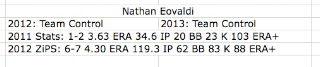
Nathan Eovaldi looks just as good as Harang at a fraction of the cost.


I need some good news.


That looks pretty good.  Almost an entire fully functioning bullpen all being paid the minor league minimum for both this year and next.  Especially since it is lead by Kenley Jansen who is absolutely nasty.  There's not much to do here besides sit back and let these guys develop...and let Javy Guerra rack up saves.  Javy is a good pitchers.  Not a great a great pitcher.  Not a really good pitcher.  Just a good pitcher.  But...if he can spend a year or two as a closer, he'll have value beyond his talent. If Guerra has 15-20 saves at the break, and a team comes calling, let him go.  


Moving on the the less happiness inducing part of the bullpen.  These guys are making actual money while not actually being any better than the cheap guys.  Guerrier is useful, but infinitely replaceable.  No real reason to give him any money.  MacDougal really isn't useful.  Any number of AAA relievers could replace his innings.  Blake Hawksworth is on the edge of usefulness.  But, his sister is hot.  


Not much to do here.  Only one long contract on the books, a bunch of major league minimum guys after that.  Trade Guerra if the opportunity presents itself.  We're not likely to compete so there's no real reason to add anyone.  We could have taken a chance on Brad Lidge who signed with the Nationals for $1.  Half a season of that and a trade would have worked out.  Similarly, we could sign Hong-Chih Kuo.


So there you have it.  Not a lot of room for making moves with Colletti doubling down on every mediocre free agent available.  

Wednesday, January 25, 2012

2012 Dodger Outlook

Less than a month until pitchers and catchers report and Ned Colletti has assembled a Dodger team that is ready to compete for an NL West title...in 2005.

Unfortunately, it is 2012.

No, really.  Check it out.

Ned reached into his bag of tricks and pulled out a handful of veterany goodness that was an exciting team half of a decade ago.  This looks like a team that will be more likely to be competing for a winning record than an NL West pennant.

So, what do we have to look forward to.

Well, one big thing.  But, what about after April?

Unfortunately (I don't drink, but if you do you and are in need of a drinking game go ahead and drink whenever you read the word 'unfortunately'), Ned signed every gritty veteran player to a 2 year contract this off-season.  That means we'll have to suffer through this same mediocre Dodger team not only in 2012, but again in 2013.

There's not much flexibility, or opportunity, in the roster for the next 2 seasons, but let's take a look at what could happen.  AKA what I think should happen.

We'll go position by position.  Starting with:

Right Field

Andre ended last season prematurely with a knee injury and his power numbers took a pretty big hit from what we're used to seeing from him.  He still managed to be productive though.  Andre is in his last year of arbitration in 2012 and will be a free agent after the season.  He's a good player, but probably not the guy the Dodgers need to commit to at this point.  He's a poor defensive outfielder.  His -9.7 UZR/150 is 2nd to last amongst qualified right fielders since 2009.   He also has a well documented struggle against left-handed pitchers.  According to FanGraphs' splits, Andre has a .386 wOBA against righties and a .292 wOBA vs lefties.

The best case scenario here is that Ethier comes back and shows that his knee is healthy in spring training then gets off to a good start so he can be traded at the deadline.  I'm not going to speculate as to which teams might be interested in Andre, or what we can get for him.  Ideally, some young players that will be ready to contribute in 2014.  Moving Ethier will bring in some young talent and open up right field for...


Kemp is coming off a near MVP season.  I could spill gallons of virtual ink writing superlatives for Kemp, but that's not necessary, I'll just spill a few ounces.  Kemp was just a few hits short of winning the triple crown.  He was 2nd in the league to MVP Ryan Braun in both wOBA and wRC+.  He was 1 home run away from 40/40.  He lead the NL in both fWAR and bWAR by a hefty margin.  He was rewarded with an 8 year $160 million contract.

Unfortunately, Kemp is miscast as a center fielder.  Like Ethier, Kemp's UZR/150 is closer to -10 than to average.  Kemp checks in at -9.3 over the last 3 years.  That's 3rd worst in the majors.  As a right fielder, Kemp would have solid range and a strong arm, he'd probably be a plus defender for the next few seasons in right.

Center Field
Matt Kemp will start off 2012 in center.  After we trade Ethier for a boatload of riches we'll need someone else to play there.  That someone is, quite obviously
Tony is certainly not Kemp's equal with the bat.  Kemp hit more home runs in September last season (8) than Gwynn has in his entire career (7).  But, where Kemp is one of the worst defensive center fielders in baseball, Gwynn is one of the best.  The best, in fact, according to FanGraphs with a 20.8 UZR/150.  That's a 30 run difference in defense.  That's significant.

FanGraphs WAR says that Gwynn has been about a 2 WAR player over each of the last 3 seasons in limited playing time.  That's certainly a bargain about a million dollars a year.  On a team that's not likely to be contending, Gwynn makes a fine, cheap, center fielder.

Left Field
Is a bit of a mess.  Gwynn will likely start off the season splitting time with
Rivera started 2011 with the Toronto Blue Jays and played so poorly that he was released.  Unfortunately, Ned figured that meant he was totally worth paying a few million dollars for.  To Ned's credit, Rivera played better in Dodger blue.  Rivera had a 79 OPS+ with Toronto and a 105 OPS+ in LA.  Unfortunately, neither one of those numbers is good enough to be a staring left fielder.

Fortunately (ehh...don't drink), Rivera does have some use against left-handed pitchers.  He has a career wOBA of .353 (116 wRC+) vs left-handers compared to a .326 wOBA (98 wRC+) vs right-handers.   That's not an extreme split, but...I'm searching for some reason not to absolutely hate having him on the team.  I've already discussed Ethier's struggles vs lefties.  Gwynn also shares that affliction.  Having Rivera around to face lefties for those guys isn't a terrible idea.

After Gwynn moves to center field to replace Kemp who will be replacing the traded Ethier, Rivera wouldn't be a terrible choice to play LF full time.  He's not the only option, though. 
Any of these guys could get some playing time in the majors.  Trent Oeltjen is the old man of the group. He's 29 and has 99 major league games under his belt.  He's not that good though so if any of the younger prospects breaks out in 2012, we could see them big the club.

You'll notice one name is conspicuously absent, more on him in just a minute.

But first

First Base
James Anthony Loney is the incumbent.  The Dodgers have had high hopes for James Loney since drafting him 19th overall in 2002.  Loney made an impressive major league debut in 2006.  Since then, Loney has, unfortunately, been one of the worst every day first basemen in baseball; he's produced 8.6 fWAR, which is just a bit more than guys like Albert Pujols, Joey Votto and Prince Fielder produce in 1 season.  James is also coming off one heckofa weird season.

Loney started off last season hitting to a .208 wOBA.  That's 74% worse than an average major league hitter.  He straightened it out in May and June, hitting a very James-Loney-like .342 wOBA.  Then, he cratered in July, somehow hitting worse than he did in April.  Then, he turned into Miguel Cabrera for the final two months of the season; putting up .451 and .424 wOBAs.

So, what the hell?  There are about 6 months in a major league season.  For 2 of them he hit like Clayton Kershaw.  For 2 of them he hit like James Loney.  And for 2 of them he hit like Miguel Cabrera.  What's he going to do this year?

Most likely, he's going to hit like James Loney, that's who he is after all.  That's just not good enough.  If that's the James Loney we get we should try and trade him for anything we can at the deadline and move on at the position.

What if he hits like Miguel Cabrera again?  Then we have some deciding to do.  We have to decide if it is for real.  If it is, we need to look into signing him to a long term contract.  If it isn't, we need to trade him to someone who thinks that it is real.  

If Loney gets traded, then first base belongs to
Sands jumped onto the Dodgers' radar after a huge 2010 in which he hit 35 home runs between A and AA.  He was called up to bigs early in the 2011 season, and struggled. He returned to Albuquerque where he put up decent numbers then ended the season in LA where he hit .415/.493 over his last 20 games.  Sands may, or may not, be a major league quality first baseman.  He's not a sure thing, but he's got good plate discipline and developing power.  If he doesn't hit enough for first base, he's an option in left field as well.

Second Base
Belongs to
Mark Ellis turned a season in which he was 32% worse than an average hitter into 2 years and $8 million.  Thanks, Nedo.  Ellis was terrible with Oakland (.246 wOBA about 50% of an average major league hitter's production) before bouncing back a bit with the Rockies (.313 wOBA).  If we get the Mark Ellis that the Rockies got, he's a useful player.  I'm not betting $8 million on it though.  Ellis is 35 this year and most of his value comes from defense.  Defense is the first to go with age.  This could get ugly real fast if Ellis' hitting is gone and his defense goes.  Good thing we're locked into him for 2 seasons.

Third Base
I kinda liked the move to acquire
before the 2011 season.  He was coming off two resurgent years with the Giants.  He played strong defense.  He had some pop.   Most knowledgeable Dodger bloggers panned the signing.  They were right, at least for 1 year.  Uribe was horrid last year.  So much so that he became a meme.  There is some hope for a bounce back.  Uribe wasn't healthy last season.  Being healthy and playing regularly has to lead to better production.  He still had a positive UZR rating.  Even though he didn't hit, it appears that he could field.  That give ME hope there is something left in the thank.  There better be.  He's going to be on the roster and in the starting lineup for two more years.

Short Stop
Here, watch some of these.

I'll wait.

I don't know how good Dee Gordon is going to be.  He doesn't walk.  He strikes out too much.  He has no power.  He weighs less than an ounce of helium.  But dude is fast.  And electric.  Seriously, just watch those videos.  Let him play.  We've got to see what we've got.

Other Infielders
Jerry Hairston jr isn't a bad player.  He plays the infield.  He plays the outfield.  He can hit the ball out of the stadium now and again.  He's better than Aaron Miles.  He's not as good as Jamey Carroll.

Adam Kennedy.  He played DH for the Mariners last season.  He must be able to hit right?  No?  Then why are we paying him twice what we'd pay Justin Sellers to do the same thing?  Why isn't the battle for 2nd back up infielder between Justin Sellers and Ivan DeJesus?  DeJesus projects to the same line as Kennedy (.321/.353 85 OPS+).  Whatever Ned.  At least Kennedy is only around for 1 season.

Catcher
AJ Ellis finally gets his shot at age 31.  Ellis has a career OBP of over .400 in the minors and over .440 in AAA.  He's got no power; 19 home runs in over 2000 trips to the plate.  But, he's been able to get on base.  At worst, he's a major league back-up catcher.  Maybe he's even a starter.  The offensive bar for catchers is very low.  Major league catchers hit just .313/.389 last season.  If Ellis reaches his ZiPS projection of an 87 OPS+ that'd put him in the same offensive bracket as Geovany Soto, Jarred Saltalamacchia, and AJ Pierzynski, and other catchers with impossible names to spell.  A couple years of league average catching at minor league prices is very valuable.


Tim Federowicz was acquired in a *%%#(&*(#$(**)#'n dead line deal involving the Boston Red Socks and Seattle Mariners.  The reports on him aren't glowing.  Good defensive catcher.  Might not hit enough to play full time in the bigs.  Well...Fex-X (as he's called.  What's up with catchers and names that are hard to spell?) spent most of last year in AA.  I'd let him continue to get experience, either there or AAA Albuquerque, while AJ Ellis takes his shot in the bigs.  Ideally, Ellis would impress enough to claim the starting spot allowing Fed-X to stay in the minors until late in the season when he could come up and play back-up for a month or two.

There you have it.  The complete plan for the Dodgers' non-pitchers for 2012.

Look for a similar post for the pitchers soon.